Best Life OKC Next Steps Journal
Should We Fix Up Mom's House Before We Sell It?
You're standing in Mom's kitchen looking at countertops that were new sometime in the nineties, carpet that's seen better decades and a bathroom that hasn't been touched since before you had kids of your own. And you're wondering: Do we hav
September 23, 2026
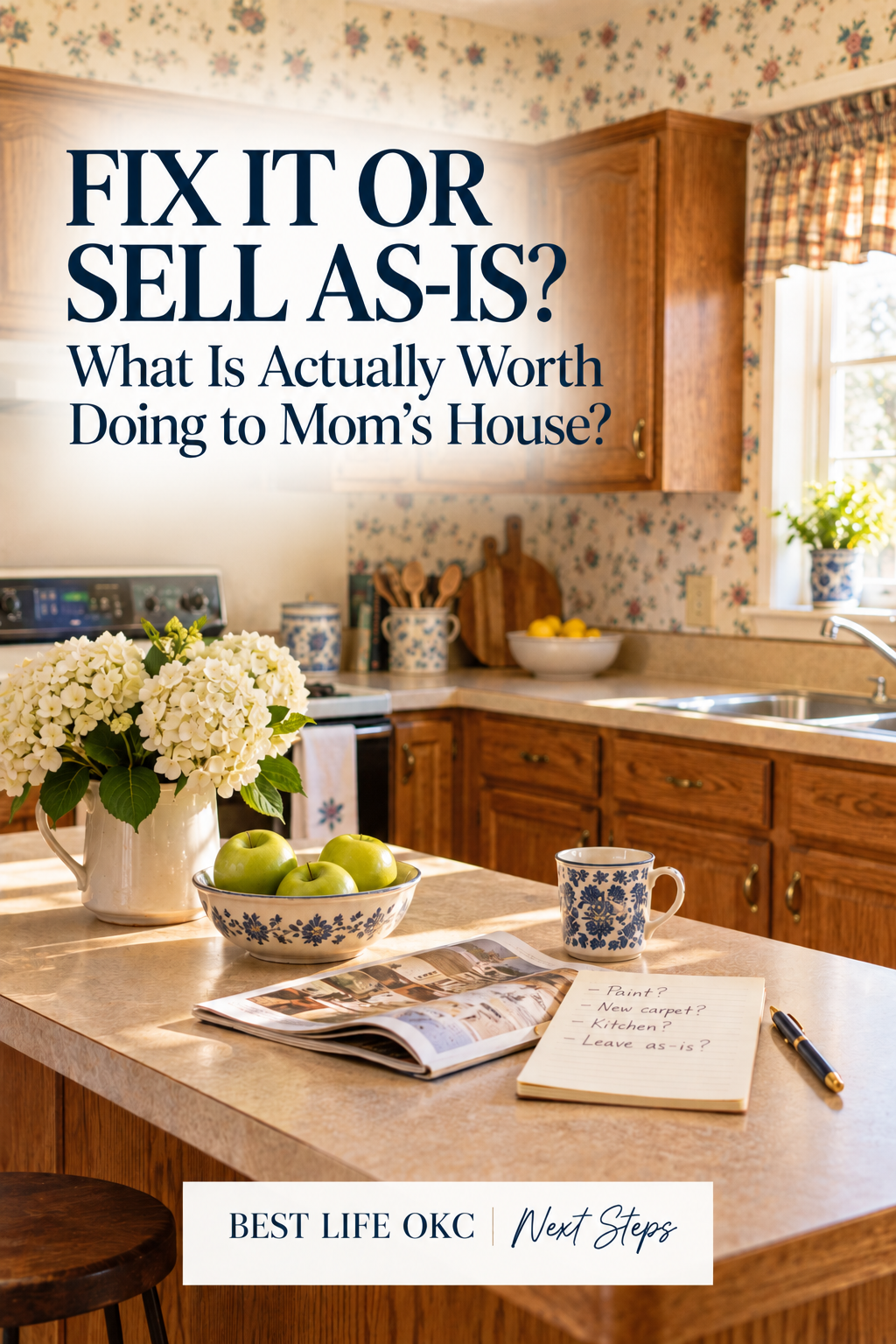
You're standing in Mom's kitchen looking at countertops that were new sometime in the nineties, carpet that's seen better decades and a bathroom that hasn't been touched since before you had kids of your own.
And you're wondering:
Do we have to fix all of this?
This is one of the most common questions families ask me when they're beginning to think about what might happen with a parent's longtime home.
My answer is usually:
Probably not as much as you think. But let's look at the house before you do anything.
Sometimes making improvements absolutely makes sense. Sometimes leaving the house just as it is makes more sense. And sometimes a little paint and carpet can go a surprisingly long way.
The right answer depends on the house, the neighborhood, the price point, its current condition, comparable sales and, just as importantly, what matters most to your family.
Dated Doesn't Mean Something Is Wrong
This is the first distinction I want families to understand.
A house can be dated and still be a perfectly good house.
Oak cabinets, older countertops, wallpaper, brass fixtures or carpet you wouldn't choose today don't automatically need to be replaced.
Then there are things that may deserve a closer look. An aging roof, signs of a plumbing problem, foundation concerns or electrical and mechanical systems that may need further evaluation are a different conversation.
Before spending money on either category, I like to look at the whole picture.
What is the home likely worth in its current condition? What are comparable homes doing in the neighborhood? Who is the likely buyer at this price point? What is the condition of the competing homes? Would making an improvement meaningfully change the home's value or make it appealing to a larger group of buyers?
If we see something that needs expertise outside of mine, that's when we bring in the appropriate inspector, contractor or other licensed professional.
The goal isn't to fix everything. It's to understand what you're working with before you start spending money.
Not Every Update Pays You Back
It's easy to think, If we put $30,000 into the house, surely we'll get that $30,000 back.
Real estate doesn't always work that neatly.
A new kitchen may increase what someone is willing to pay for the house, but that doesn't necessarily mean it increases the value enough to cover the entire renovation.
And here's where I'll admit my own bias.
Personally, I'd rather buy “Grandma's house” that hasn't been touched and make the updates myself than pay for someone else's choices and then have to undo them.
I like being able to hire people I trust, choose what I want and know the work was done well. There's peace of mind in that.
And there are buyers out there who feel exactly the same way.
But there are also plenty of buyers who cannot see the vision yet.
They walk into a dated house and have a hard time imagining what it could be. Or they may love the house but simply don't have the extra cash after closing to replace flooring, paint the interior and remodel a kitchen.
For those buyers, a home that's already had some thoughtful improvements can be much easier to say yes to.
That's why I don't have one answer about updating.
Sometimes updates make sense, and sometimes they don't.
The neighborhood matters. The price point matters. The condition matters. The comparable sales matter. And the buyer we are most likely trying to reach matters.
All of those things help us make the right decision for that specific house.
First, Decide What Matters Most to Your Family
There's another part of this decision that has nothing to do with countertops.
What does your family need from this process?
Maybe keeping things simple is the priority. Mom doesn't want a renovation going on around her, or the family simply doesn't have the bandwidth to manage one.
Maybe timing matters more than squeezing every possible dollar out of the property.
Or maybe maximizing the family's net proceeds is the priority, and you're willing to put some time and money into the house if the numbers support doing it.
Those are different goals, and they can lead to different recommendations.
Leaving a home in its current condition may mean accepting a somewhat lower price. That's not necessarily a bad decision if it saves your family months of work, expense and stress.
On the other hand, if maximizing the dollars from the sale is most important, we can look at what strategic improvements could make a meaningful difference. I have a number of trusted contacts who do excellent work, and I've seen them completely transform properties.
The important thing is that we decide what we're trying to accomplish first.
Then we decide what, if anything, is worth doing to the house.
Sometimes Small Things Make the Biggest Difference
Preparing a house doesn't automatically mean remodeling it.
Sometimes new carpet and fresh paint go a long way.
A deep cleaning can completely change how a home feels. So can clearing crowded countertops, removing some excess furniture, trimming overgrown landscaping, washing windows and simply letting more light into the house.
Those aren't glamorous improvements, but they can help buyers see the home instead of being distracted by everything around it.
There are also times when I walk through a house and say:
Don't touch it.
I'd rather price it appropriately and let the next owner make it theirs.
This is why I really prefer to see the house before families start making changes.
If we're going to ask you to spend money, coordinate contractors or give up weekends working on the house, I want there to be a good reason for it.
Sometimes Doing More Is Worth It
I don't want to make it sound like I'm always Team Grandma's House. Although, personally, I kind of am.
There are absolutely properties where doing more work before selling makes financial sense.
Maybe the comparable sales show a meaningful difference between homes that have been updated and those that haven't. Maybe one part of the house is keeping buyers from seeing everything else it has going for it. Maybe the likely buyer at that price point expects a more move-in-ready home.
Or perhaps we know buyers in that particular market are stretching to come up with their down payment and closing costs. They may be able to finance the purchase of the house, but they don't have another $25,000 sitting around for immediate updates.
In those situations, thoughtful improvements may open the home up to a much larger pool of buyers.
That's where we look at the numbers.
What might the house be worth as it sits?
What might it be worth with a few strategic improvements?
What will those improvements cost?
And just as importantly:
How much time and effort will they require from the family?
The highest sale price isn't automatically the best outcome if you had to spend a significant amount of money and months of work to get there.
I'm much more interested in the whole picture.
Selling As-Is Can Be a Good Option Too
For some families, selling the home in its current condition makes the most sense.
That might be because the house needs significant work. But it can also be because Mom or Dad doesn't want to spend money updating a home they may be leaving, the family doesn't have the time or bandwidth to manage projects, or the expected return simply doesn't justify the expense.
Selling as-is doesn't mean we don't care how the home is presented.
We can still clean, declutter where appropriate, use professional photography, market the property thoughtfully and price it strategically.
It simply means we're making an intentional decision about where not to spend your family's time and money.
There are buyers looking for exactly those houses.
Let Me See the House Before You Start
If there's one thing I wish families would do when they're beginning to wonder what to do with a parent's longtime home, it's this:
Let me see it before you start fixing things.
You don't have to have decided to sell.
You don't have to clean it up first.
You don't need to empty the closets or apologize for the wallpaper.
Seriously.
I want to see the house as it really is.
We can walk through it together and talk about what I'm seeing from a real estate perspective. I can show you what comparable homes are doing, what today's buyers in that particular market tend to expect and where I think spending money could make a difference.
And I can also tell you where I think it won't.
If we need more information about the roof, foundation, electrical system or another part of the property, we'll identify the right professional to evaluate it.
Then your family has real information to work with, whether you're planning to make a move soon, considering one down the road or simply trying to understand your options.
A Note About Trusts and Estates
If the home is owned by a trust or is part of an estate, there may be additional considerations before money is spent or work is authorized.
That's where I want the appropriate attorney, trustee, personal representative or other professional involved.
I'll stay in my lane and help with the real estate and home side of the equation. When a question belongs to someone else's area of expertise, we'll bring in the right person.
You don't have to know who all those people are before you start. Part of what I can do is help you identify the questions we need answered and the kind of professional who can answer them.
Mom's House Doesn't Have to Look Like a New House
This may be the part I want families to hear most.
A home that has been loved and lived in for thirty or forty years doesn't need to suddenly look brand new.
It needs a thoughtful plan.
Sometimes that means doing almost nothing.
Sometimes fresh paint, new carpet and a good cleaning make an enormous difference.
And sometimes the numbers tell us that investing in more substantial improvements is worth considering.
There isn't one right answer because there isn't one kind of house or one kind of family.
That's why I don't want you starting with a renovation list.
Start with the house.
Start with your family's priorities.
Then let's look at the market and the numbers and figure out what makes sense from there.
And if you're standing in Mom or Dad's house wondering what on earth you should do first, I'm happy to come take a look.
You don't have to be ready to sell.
Sometimes knowing what your options are is the first next step.
A clear next step
Find your family’s place in the parent move journey.
Use the short check in and six phase resource library when you are ready for practical support.
Explore the resources